


Jeremy Allaire: AI agents will replace a huge percentage of work that's currently performed by humans
Overview
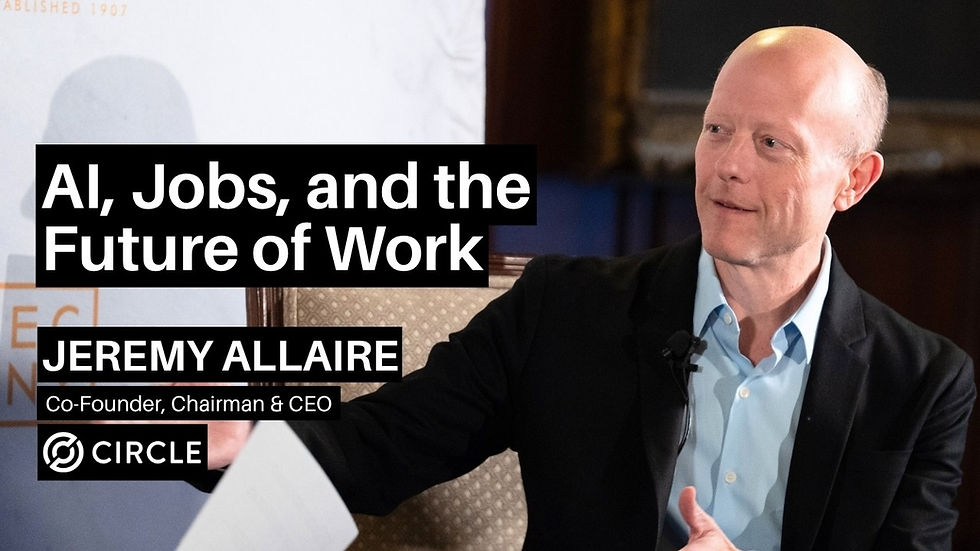
At the 834th meeting of the Economic Club of New York, Brian Sozzi, Executive Editor at Yahoo Finance and Jeremy Allaire, Co-Founder, Chairman & CEO of Circle, frames AI as a force that will fundamentally reshape the structure of the economy. The core argument: as AI begins to absorb economic activity, the underlying infrastructure of the economy must evolve with it.
This isn’t just about jobs or automation, it’s about redesigning how work, corporations, and even governments function.
What AI Actually Does to the Economy
The first-order effect is acceleration.
“Agentic AI… is going to enable dramatically higher velocity of economic activity.”
Faster decisions
Faster execution
Faster coordination
And that changes how organizations operate.
“What we even think of as a corporation will change… because of AI and because of blockchains.”
The implication is structural:
Lower coordination costs
More programmable operations
Less dependence on human workflows
The Scale of Impact
Allaire is explicit about magnitude:
“Productivity… GDP growth… across every major industry… can be transformed… in very, very significant ways."
This is not localized disruption. It’s economy-wide expansion.
The real economic impact is going to be dramatic.
At the same time, the labor impact is unavoidable.
“AI agents will replace a huge percentage of work that’s currently performed by humans.”
And it won’t be where people expect:
“It’s going to be most dramatic in white-collar work.”
This is not just automation of routine tasks, it reaches into knowledge work at scale.
The Paradox: Loss and Leverage
Allaire doesn’t frame this as purely destructive.
“If you actually embrace… these agentic capabilities, you as a person have new superpowers.”
Two dynamics happen simultaneously:
Roles are eliminated
Individual capability expands
“Your ability to have impact grows dramatically.”
So the outcome is uneven:
Displacement for some
Amplification for others
This Pattern Isn’t New
Before personal computers:
Work was manual
Systems were paper-based
“We replaced a lot of work… with paper and pens… and moved it onto personal computers.”
Then the internet:
Introduced large-scale efficiency
Transformed coordination
“You could chart global GDP growth over the expansion of this internet…”
Labor markets adapted each time.
The same pattern is repeating, but at larger scale.
What happens to the people… that get left behind?
Allaire’s view is that the issue is structural.
“There is a rethinking of the social contract that is needed.”
Because everything is changing at once:
Work
Value creation
Participation in the economy
A Vacuum of Ideas
He points to something more fundamental: there’s no modern framework for this transition.
“Tell me who to read. You can’t find them.”
Historically, major shifts were accompanied by new thinking:
Enlightenment philosophers
Industrial Revolution economists
“They were… creating a vision for how we might structure our political economy.”
That layer is missing today.
The Scale of the Moment
Allaire doesn’t downplay it:
“These are changes as big as the Enlightenment… probably as big or bigger than the Industrial Revolution.”
Which means not just economic change but also institutional change.
What Comes Next
AI will:
Increase productivity
Redefine corporations
Replace large categories of work
But the surrounding system hasn’t caught up.
The core problem is in redesigning the economic and social structures around AI.
And right now, that work hasn’t started.
Comments